

Longevity Escape Velocity
What happens if we suddenly live 100 years longer?


👋Hello, my friend. This week, I’ve been deep down the longevity rabbit hole. I’ve returned feeling intrigued by a concept called ‘longevity escape velocity’ and all the questions that this idea raises for how we live our lives today. I want to talk to you about that and share some of the best content I’ve consumed on the topic.
Let’s do it!
Longevity Escape Velocity
There’s a concept in the longevity community — apparently coined by Ray Kurzweil and Aubrey De Grey — called ‘longevity escape velocity.’
It’s the idea that at some point (possibly in the near future), science will able to add more than one year of additional life for each year you live…. basically extending your life indefinitely.
Today, by some estimates, science and technological advancements are adding roughly 3 months to your expected lifespan for each year you live. Once that 3 months becomes more than 12 months, in theory at least, we reach escape velocity.
If you’re a visual person, here’s how VC firm NfX has illustrated the concept.
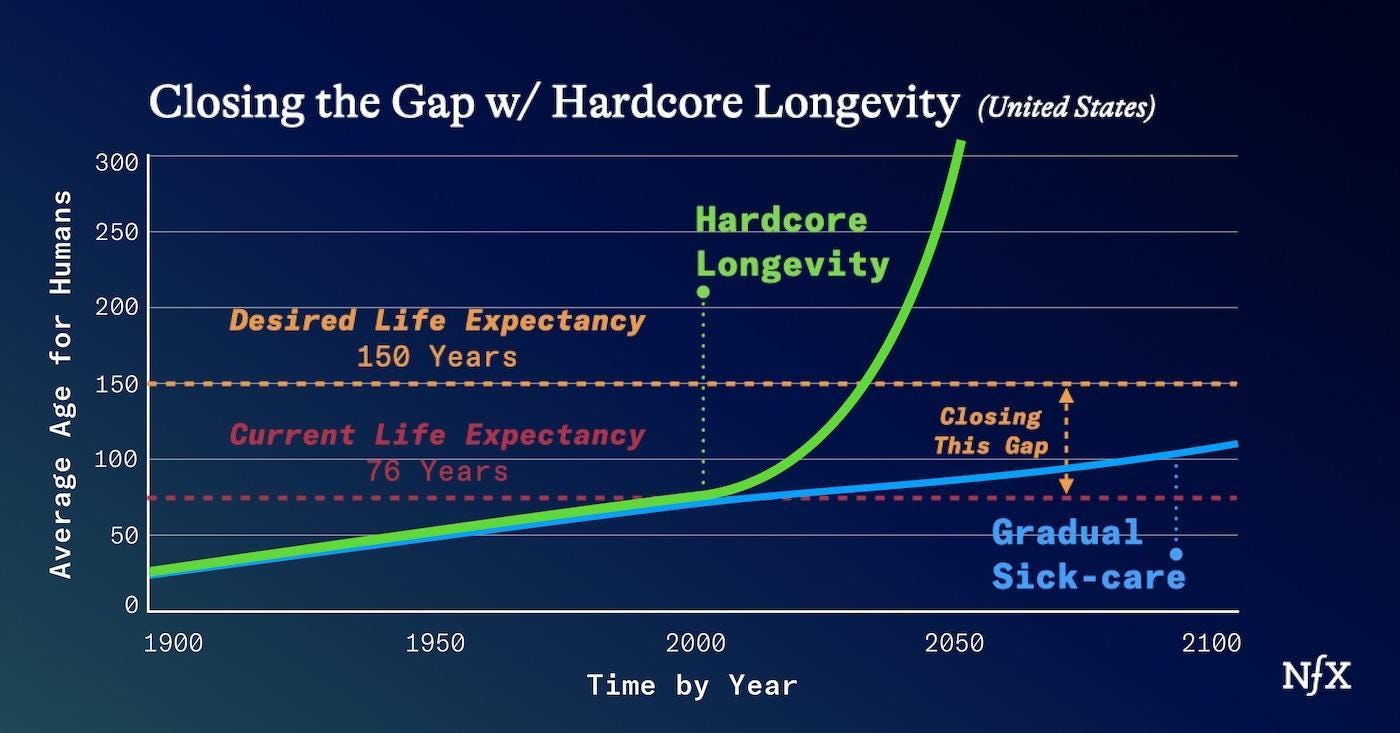
Today, in my estimation, this concept of longevity escape velocity is somewhere between science-fiction and extreme optimism — but I wouldn’t categorize it as pure fantasy.
What’s interesting, and related to my AI article last week, is how fast (at least some of the most optimistic) technologists & scientists think this could happen. Here’s an excerpt from a recent podcast with author Peter Diamandis on this topic:
“So today for every year that you're alive, science is extending your life for a quarter of a year or thereabouts. Ray Kurzweil, Aubrey de Grey talked about this idea that in the future, for every year that you're alive, science is going to extend your life for more than a year. And that's called longevity escape velocity.
So when will that happen? Well, Ray Kurzweil believes it will be by 2030 or by the end of the year 2030. He's got an 86% accuracy rate in his predictions. Pretty damn good.
… George Church and David Sinclair, both Harvard professors in this field, their prediction is mid to late 2030s. Even if it's 2040, the point I'm making is, okay, that's, you know, call it 15 years from now. Your job is not to die from something stupid in the interim and to give yourself the maximum chance to intercept these breakthroughs coming. You don't want to be the last person to miss it, so to speak. Sometimes I feel like, yeah, I'm right on the edge of that.”
Impacting how you live today
The point of this article is not to determine if longevity escape velocity is pure fantasy or just around the corner. I’m not qualified to make that determination.
Rather, it’s more of a thought experiment, posing this question to you:
If you knew that in 15 years (2040), humans would reach escape velocity — meaning that if you made it to that year, you could live indefinitely — what, if anything, would you do differently today?
It’s a super interesting question, I think. And while it’s for you to consider yourself, here are a few ways I would think about answering it:
Don’t die from anything avoidable in your day-to-day life — My mind immediately goes to avoiding things like car accidents, drunk driving, drug overdoses, even falling off ladders. Just avoiding unnecessarily reckless behavior.
Don’t die from avoidable/preventable diseases — In my view, some of the best work that’s been done on avoiding things like heart disease, diabetes, cancer, and dementia has been done by Dr. Peter Attia in his book, Outlive, which I gave an overview of here. My thinking has changed dramatically in recent years on what’s possible in terms of reducing your chances of all of the above with lifestyle changes and early and aggressive screening. If you’re not familiar with Attia’s work, the podcast I’ve included below is an EXCELLENT 1-hour overview of his philosophies and recommendations on all of these fronts.
Keep my body and mind as healthy as I possibly can — I’m 46. If I think about dying at 86, that means my body has to hold up for another 40 years. And I’m not super interested in being either in pain or immobile for the last ten or more years of that. So I’m already very focused on diet, strength-training and what Attia calls “the centenarian decathlon.” If I think about dying at 146, that’s a hundred years! That’s a whole lot of extra time to plan for.
I guess there’s two ways to look at this:
1. I should be eating as healthy as possible, working out daily, sleeping 8 hours/night, and managing my stress to make sure that my body is as prepared as possible for so much additional life, or…
2. I can assume that if we ‘solve’ ageing, that means we’ll also be rolling out the Ozempic for heart heart, mental health, etc., and that cancer would have been cured. So I can drink, smoke, party, and eat whatever garbage I want because science will save me.
You probably already know where I’m going to land on that one. I’m already convinced that almost every human ailment can be made better (or avoided) through diet, exercise and sleep. So I’m going to stay focused there but I think I’m even more motivated knowing that I may be ‘training’ for a much longer game than originally anticipated.Keep striving for meaning, purpose and connections — Life for life’s sake maybe isn’t all that valuable. But life with purpose is everything. I would want to try to optimize everything I do to serve a purpose bigger than me and to connect deeply with other people along the way.
Of course, once you tell people to consider what they’d do if they suddenly had an extra 100, 50, or even 30 years of life to plan for, the questions become pretty overwhelming pretty quickly:
Would I WANT to live that much longer? (To me, the obvious answer is yes, but only if in those years I could be happy, healthy, mobile, etc. I think people answering ‘no’ would assume they’re in pain, or incapacitated, or alone in a nursing home somewhere which I understand would not be a great existence).
Will I be happy in my current relationship for that long?
Can I afford to live that long? Or would I need to make some changes?
Could I accomplish something I thought had passed me by?
Do my religious beliefs need an update?
And then, of course, like any great thought experiment, it can lead you back to this question: Do I really need to live an extra 50 years to ask myself all of these questions in the first place? Or is there a change I want to make today regardless?
For me, I like the idea of dreaming of what’s possible on one hand and on the other hand staying grounded in the reality of what’s achievable today how I can realistically impact it for the better.
Anyhow… lots to think about, but I’ll leave it there for today.
Thanks for reading. Hope you keep reading for the next 100+ years.
Greg
Content Diet
🎙️Rich Roll & Peter Diamandis — Slow, Stop & Reverse Ageing
I would put this conversation in the category of ‘dreaming of what’s possible.’ Roll and Diamandis talk about where the latest cutting edge longevity technologies and treatments are and where they are heading.
🎙️Peter Attia ‘The Drive Podcast’ — Longevity 101: a foundational guide to Peter's frameworks for longevity
I’d put this conversation firmly in the ‘what can I actually do about all of this longevity stuff today’ category. If you haven’t read Outlive or aren’t familiar with Peter’s work, this is a GREAT overview of his philosophies and protocols around things like diet, exercise, sleep and aggressive and early screening for disease.
Thanks for reading as always. See you next week.
Greg